
Kabaddi
Kabaddi: From Rule Structure to Commercial Reality
কাবাডি একটি সাত বনাম সাত দলগত খেলা, যা ১৩ মিটার × ১০ মিটার কোর্টে দুই অর্ধে ২০ মিনিট করে খেলা হয়। আক্রমণকারী রেইডারের হাতে থাকে ৩০ সেকেন্ড এবং তাকে অবিরাম 'কাবাডি' ধ্বনি দিতে হয়; ধ্বনি থামলে রেইড বাতিল। স্পর্শে ১ পয়েন্ট, ট্যাকলে ১ পয়েন্ট, বোনাস লাইনে ১ পয়েন্ট, সুপার ট্যাকলে ২ পয়েন্ট, একক রেইডে ৩+ পয়েন্টে সুপার রেইড, এবং সাতজন আউট হলে প্রতিপক্ষ ২ বোনাস পয়েন্টসহ অল আউট পায়। দুটি রূপ প্রচলিত: স্ট্যান্ডার্ড স্টাইল (আয়তাকার কোর্ট, প্রো কাবাডি League ও এশিয়ান Games) এবং সার্কেল স্টাইল (বৃত্তাকার মাঠ, পাঞ্জাব ও পাকিস্তান)—দুটির Statistics তুলনাযোগ্য নয়। International ক্ষেত্রে স্ট্যান্ডার্ড স্টাইলে ভারতের একাধিপত্য; একমাত্র ইরান ২০১৮ জাকার্তা এশিয়ান Gamesে ভারতকে হারিয়ে সোনা জেতে। প্রো কাবাডি League ২০১৪ সালে ৮ দল নিয়ে শুরু হয়ে বর্তমানে ১২ ফ্র্যাঞ্চাইজিতে পৌঁছেছে এবং ক্রিকেটের বাইরে ভারতের সবচেয়ে সফল পেশাদার League। কাঠামোগত ঝুঁকির মধ্যে রয়েছে একক সম্প্রচারকারী নির্ভরতা, নিলামে খ্যাতি-প্রিমিয়াম, ফেডারেশন অস্থিরতা এবং প্রো কাবাডি Leagueে মহিলা Leagueের অনুপস্থিতি।
Many people still picture kabaddi as a village fair pastime or a school break game. The reality is very different. On a defined court 13 metres long and 10 metres wide, with seven players a side and a hard 30-second clock, the tactical depth is no shallower than football or basketball. The core difference lies in one place: in kabaddi, attack means one man's time-limited incursion, and defence means physically containing that incursion. Inside that simple structure sits a scoring model that confuses spectators and analysts alike.
Raid: a thirty-second solo incursion
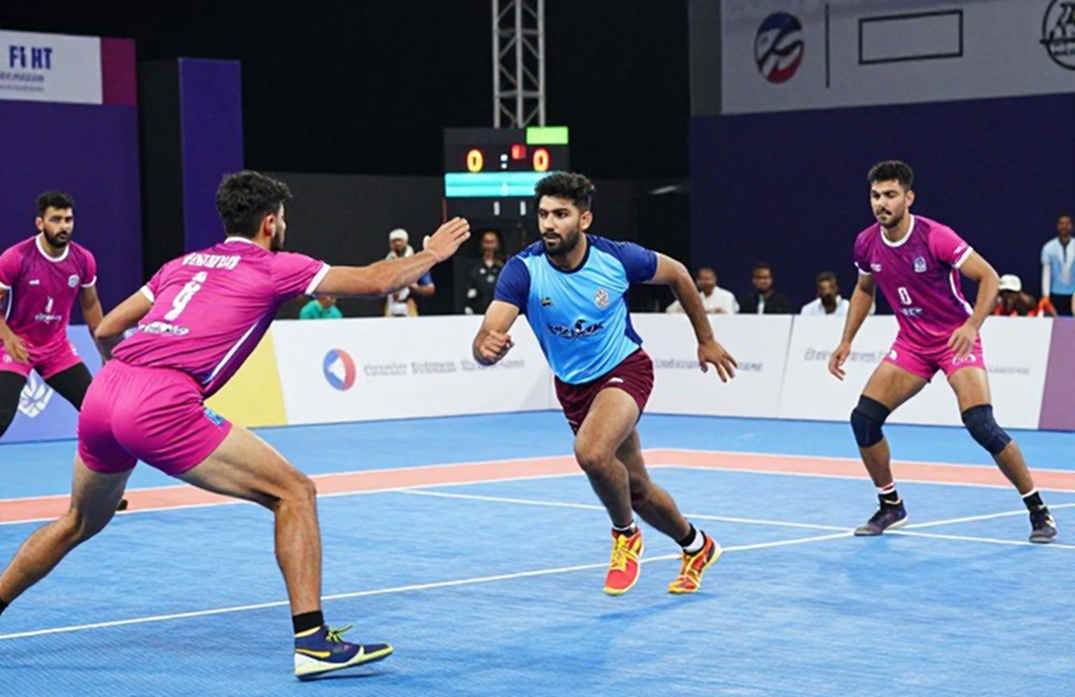
The raid is the central event of kabaddi. Each side alternates sending one raider into the opponent's half. That raider has only thirty seconds in which to touch one or more defenders and return safely to his own half. A touch is worth one point. But the real condition is the return—if he is caught by an ankle hold, a waist hold, or a coordinated block, the defending side scores and the raider goes to the out-box. Every raid is therefore both attack and risk; a failed raid does not merely lose a point, it thins the team.
Cant: a timer that runs on the human voice
The thirty seconds are counted by an odd but effective mechanism called the cant. From the start of the raid until the return, the raider must chant 'kabaddi-kabaddi' continuously. The purpose is singular: to prove he is not taking a breath. The moment the chant breaks, the raid is dead—and any point earned in that raid does not stand. The timer of this sport is not a machine but a human throat. That single rule gives kabaddi a visible theatricality no other team sport possesses.
Tackle: defence scores too
The defence's only route to scoring is the tackle. Together the seven defenders stop the raider inside their own half—ankle hold, thigh hold, block, or a linked chain of two or more players—and earn one point. Note that defence in kabaddi is never passive; it is one of the primary sources of scoring. This is why a good defence in kabaddi means an aggressive, risky but coordinated system, not simply standing back and waiting.
From the bonus line to the all out
A line is marked deep in the opponent's half—the bonus line. Crossing it while the defence has six or more players on court earns the raider one extra point. In plain terms this is a courage bonus: a reward for going deep into danger. This rule divides raiders into two types—the deep-running bonus hunter and the touch-and-return percentage raider. Judging a raider by total raid points alone buries that distinction entirely.
The biggest swing in scoring comes from the all out. When all seven players of a side end up in the out-box, the opponent gets two bonus points and the wiped-out side returns to the mat fully revived. This one rule makes kabaddi's score non-linear. A six-point lead with ninety seconds left is not safe in kabaddi the way it would be in football, because an all out can erase it in seconds. An analyst who reads a kabaddi scoreline like a football scoreline will misjudge the very idea of game control.
Attached to this is the do-or-die rule. If two consecutive raids yield nothing—no touch, no bonus line—the third raid becomes do-or-die; fail that one and the raider himself is out. The rule forcibly converts cowardice into self-destruction. A team cannot simply burn the clock with empty raids; do-or-die forces it to accept risk. This is one of the structural reasons kabaddi's scoring density is so high.
Two special bonuses change the rhythm of a match. A tackle completed while the defence has three or fewer players on court is a super tackle, worth two points—a comeback bonus for a depleted defence. A single raid scoring three or more points is a super raid. Matches run over two halves of twenty minutes; the Pro Kabaddi League adds timeouts and rolling substitutions, which turn raider rotation into a genuine tactical lever.
Standard style versus circle style
Here lies the largest confusion. Kabaddi exists in two forms—standard style and circle style. Standard style is the rectangular court, seven-a-side form used by the Pro Kabaddi League and the Asian Games. Circle style is the circular-field form of one attacker against one defender, popular in rural Punjab tournaments and in Pakistan. The scoring detail and the tempo of the two differ materially; statistics from one form cannot be compared with the other. The commonest error in media coverage is failing to state which form is being discussed.
Competition tiers and the prestige trap
Understanding the tier matters, because the biggest error in kabaddi coverage is prestige inflation. The Pro Kabaddi League, launched in 2026 with eight teams and now at twelve franchises, is the only non-cricket Indian league to have achieved sustained mainstream scale. Beyond it sit the Asian Games, the Asian Indoor and Martial Arts Games, and the international federation's World Cup. But a regional invitational and an Asian Games medal cannot be placed on the same shelf.
The only reliable way to avoid that confusion is to identify the sanctioning body—the International Kabaddi Federation, the Amateur Kabaddi Federation of India, the league operator Mashal Sports, or a state government. That single field settles most prestige disputes. It is worth remembering that two different competitions have historically carried the name Kabaddi World Cup: the IKF's standard-style World Cup and the Punjab government's circle-style World Cup. Conflating them produces a false signal of internationalisation.
The international power structure divides broadly into monopoly and challenger. In standard style India has held a long monopoly. Only Iran has broken it—at the Jakarta 2026 Asian Games, Iran beat India in the men's final to take gold, and made progress on the women's side in the same cycle. The next tier holds Bangladesh, where kabaddi is the national sport with deep grassroots but a thin professional layer; South Korea, with systematic training and league exposure; and Pakistan, a circle-style stronghold where fixtures against India carry intense political charge. Beyond that lie Nepal, Sri Lanka and Kenya—a broad but shallow development ring.
A geographic map of talent
Understanding India's talent map is a precondition for analysing this sport. Haryana carries a power-based defensive tradition; Maharashtra is the birthplace of modern standardised rules and systematised coaching; Punjab is the circle-style heartland and the strongest cross-border cultural bridge; Uttar Pradesh is a vast grassroots reservoir; Tamil Nadu is the school of raid technique. Without this map, neither a squad's construction nor a player's style can be explained. Internationally, Iran brings wrestling-derived physicality; Bangladesh has kabaddi as its national sport but a thin professional layer; South Korea has combined systematic training with league experience; Pakistan holds a strong circle-style tradition.
Culture: the greatest asset, the most fragile trap
Kabaddi's social narrative is its most powerful commercial asset and its most fragile analytical trap. The sport is genuinely rural, mud-court born, a product of the akhada training-ground system. The claim that kabaddi changes a family's fate is a real and verifiable mobility pathway, reinforced by absorption into railway, police and army jobs and by honours such as the Arjuna Award. As individual biography this narrative is authentic; presented as a trend or general rule it is frequently exaggerated. Analysis must therefore separate two layers: verifiable biographical facts and media framing. Without that split, nothing about the hype-to-kill cycle can be dated or measured.
International readers need a workable anchor. After cricket's Indian Premier League, kabaddi is India's second most-watched sports property—meaning it should be read not as a folk game but as India's most successful non-cricket professionalisation project. The closest cultural analogue is the conversion of a traditional wrestling or folk sport into a broadcast product.
The gender dimension is the sport's least discussed structural weakness. Women's kabaddi exists and is an Asian Games event, but the Pro Kabaddi League has no women's league. This is not a one-season issue but a pipeline risk: there is no visible professional ladder for women players.
Commercial structure and the auction trap
The most notable feature of the commercial architecture is vertical integration. The league operator Mashal Sports sits inside the Star and Disney Star network, and media rights are concentrated with the same group. Add to that title sponsorship by domestic consumer brands and city-franchise ownership by Indian corporate groups and film stars. Three vulnerabilities deserve testing: dependence on a single broadcaster, the near-zero value of overseas rights—the audience is essentially the South Asian diaspora—and ratings normalisation after the novelty peak.
A kabaddi auction demands a specific analytical method. A player's price must be checked against his efficiency output over the last two seasons—successful raid percentage, do-or-die conversion, tackle success rate—never against raw points totals alone. Kabaddi auctions reliably generate a fame premium, especially for freshly crowned national-team or Asian Games stars, and Indian media habitually present the headline price as a proxy for quality. Price is a market-expectation signal, never a measure of quality.
Governance and the Olympic pathway
Governance risk is not small, though it is the least covered layer in the media. The Amateur Kabaddi Federation of India has a documented history of election disputes and administrative turbulence, with periodic intervention by the Indian Olympic Association or the sports ministry. Player registration and transfer systems are less mature than in cricket, and post-retirement financial security is thin. Anti-doping maturity also sits below that of Olympic-mainstream sports. The league has introduced televised review, but officiating consistency in international standard style remains uneven.
Kabaddi is not an Olympic sport and has not been shortlisted in recent cycles. The obstacles are clear: the number of participating countries, thin continental spread, and above all the depth of the women's game. The realistic near-term route to internationalisation is regional and multi-sport-event based—Asian Games, Asian Indoor and Martial Arts Games—not the Olympics.
Risks and public narrative
Five items deserve priority on the risk list. First, excessive dependence on a single star raider, with the concealed injury exposure that comes with it. Second, single-broadcaster dependence at league level. Third, a salary bubble in the auction relative to commercial returns. Fourth, federation turbulence closing off the national-team pathway. Fifth, nationalist heat around India-Pakistan fixtures, which creates the risk of passing off non-sporting events as sporting analysis.
Narrative analysis must stress-test two stories hardest. The first is the succession narrative—any raider with one strong tournament is declared the next Pardeep Narwal, and historically that label has a very low fulfilment rate. The second is the internationalisation narrative—India's dominance in standard style is real, but the global participation base is very thin; dominance and popularity are different claims. Add the village-to-star inspiration story to these two, and unless fact and editorial framing are separated, nothing can be verified.
In terms of industry transmission, the Pro Kabaddi League's real significance is different. It proved that a non-cricket Indian sport could be turned into a commercially viable prime-time league through franchises, an auction, entertainment formatting and regional-language commentary. That template was later copied, with mixed results, by badminton, wrestling, volleyball and table tennis. The least discussed channel is the flow of overseas players: Iranian, South Korean and Bangladeshi players simultaneously raise the league's quality and seed the sport in their home countries.
Finally, a methodological caution is essential. In the analysis of a specialised sport like kabaddi, the greatest danger is template pressure—when a large framework exists, the urge to fill cells leads to inference being written as fact. This report presents a conceptual framework for kabaddi's rules, competition tiers, cultural background, commercial architecture, governance, risks and narratives; it is not a report of any specific match, scoreline or team result. To analyse a specific event, four facts must first be confirmed: the player names, the match date, the competition type and the sanctioning body.
Related Players
Popular Reads
Insufficient Input: No Analyzable Source Article Provided2026-11-02
India's 49-24 and 63-31: Behind the Big Margins, 31 Points Conceded and an Open Question Before Bangladesh2026-10-29
The Rs 19.2 Lakh Ceiling: How Haryana's Kabaddi Champions League Leaked Its Own Limits2026-10-16
India's 49-24 Win on Japanese Soil: Kabaddi's Real Fight Is Still Ahead2026-10-12
Asian Games 2026: India's Kabaddi Golden Double, the Iran Question, and the Minutes Pawan Sehrawat Never Played2026-10-09
Recommended
Commonwealth Kabaddi Championship 2026: India's 17 Probables and the Real Arithmetic Behind the 'Missing Stars' Debate2026-10-09
India's 49-24 Win on Japanese Soil: Kabaddi's Real Fight Is Still Ahead2026-10-12
Eleven Bonus Points: India Begin Asian Games Title Defence with 42-21 Win Over Bangladesh2026-10-08
Commonwealth Kabaddi 2026: A 13-Nation Stage, But the Real Test Lies Elsewhere2026-10-22
India's 49-24 and 63-31: Behind the Big Margins, 31 Points Conceded and an Open Question Before Bangladesh2026-10-29
Recommended
Asian Games 2026 Kabaddi — The Broadcast Gap and India's Gold Pressure2026-10-08
The Name Missing From the List: Ritu Negi, One Crore, and Himachal's Silent Rule Change2026-10-09
India 48-24 Nepal: Three Frozen Frames That Settled the Asian Games 2026 Semifinal2026-09-26
India's 49-24 and 63-31: Behind the Big Margins, 31 Points Conceded and an Open Question Before Bangladesh2026-10-29
Commonwealth Kabaddi Championship 2026: The Rest of 12 Gold Medalists, a List of 17 Probables, and the Question Nobody Is Asking2026-10-09
Recommended
Three All-Outs, Four Bonus Points: The Arithmetic Inside India's 48-24 Semifinal Win2026-09-26
Not the 37-21 Scoreline, But Chinese Taipei's 21 Points: A Tactical Decoding of India's Unbeaten Group Run at Asian Games 20262026-10-02
How the Scoreline Lies: Inside Kabaddi's Rule Architecture2026-10-31
Bonus-Line Courage and Three All-Outs: India Beat Nepal 48-24 to Reach the Final, But the Real Test Is Still Ahead2026-09-26
Asian Games 2026 Kabaddi Day 1: Bangladesh and Pakistan Top Groups2026-10-15